Key Facts
Austin rents declined 12.7% year over year as of June 2026 — but most concessions are not posted publicly. A locator knows which properties are running them. (Zumper, June 2026)
Average Austin move-in concessions: approximately $180/month across the market as of Q1 2026. (ApartmentTrends.com)
AI users convert at 4.4x the rate of organic search visitors — renters increasingly arrive having already done their research. (Semrush, 2026)
ChatGPT’s top-cited results overlap with Google’s top 10 by only 2.1% — the search landscape is fragmenting, and so is where renters find information. (Semrush, February 2026)
What is Zillow, and what does it actually show?
Zillow aggregates publicly posted apartment listings from property management companies, individual landlords, and listing services. It shows what properties have chosen to advertise at the time they posted.
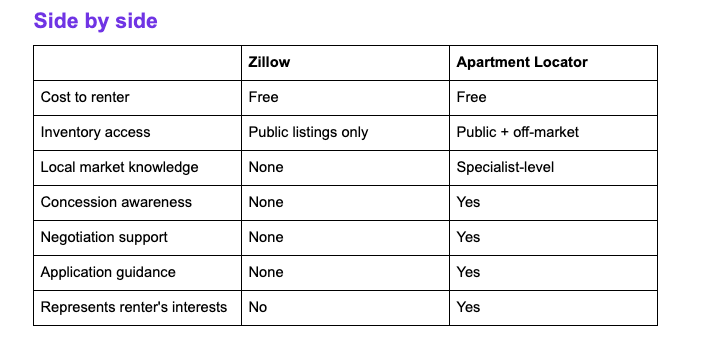
Zillow does not negotiate on your behalf. It does not have access to off-market inventory. It cannot tell you which buildings have a strong maintenance record, which complexes are in a flood plain, or which ones are currently offering reduced deposits for qualified applicants who can move in quickly. For renters who are already local and have time to search at their own pace, it is a useful starting point. For renters relocating or working to a deadline, it has significant gaps.
What does an apartment locator provide that Zillow doesn’t?
An apartment locator is a licensed Texas real estate professional who specializes in the rental market. When you work with one:
They match you to available properties based on your requirements — a professional assessment of what fits, not a keyword search
They have access to inventory that is not publicly posted, including pre-listed units and properties with immediate availability
They know which complexes are offering move-in specials, reduced deposits, or waived application fees that haven’t been listed anywhere
They schedule viewings, guide you through the application, and advise on lease terms before you sign
For a complete breakdown of everything a locator does, see What does an apartment locator do?.
The service costs you nothing — the apartment community pays the referral fee when you sign a lease
How does the Austin market change this comparison?
Austin’s current market is worth noting. As of June 2026, the city has seen 15 consecutive quarters of rent decline, with the median one-bedroom asking rent at $1,305–$1,339/month — down 12.7% year over year (Zumper, June 2026). Average concessions across the market sit at approximately $180/month (ApartmentTrends.com, Q1 2026), meaning properties are actively competing for qualified renters.
In this environment, a locator does something Zillow cannot: they tell you which properties are offering concessions that haven’t been publicly posted, and they help you negotiate from a position of knowledge. A renter searching on Zillow sees the advertised price. A renter working with a locator may walk away with a better deal on a property that fits their requirements more precisely.
When is Zillow sufficient?
Zillow works well when: you are already local, you have four to six weeks to search at your own pace, you are familiar with the neighborhoods you want, and you are comfortable negotiating lease terms independently.
When is a locator the better choice?
A locator is typically the better choice when: you are relocating from another city or state, you have a tight move-in deadline, you want access to inventory that is not publicly posted, or you want professional guidance on lease terms, deposits, and move-in costs before you commit.
Sources
Texas Apartment Association, apartment locator role in Texas rental market: texasapartmentassociation.com
Zumper, Austin rent research, June 2026: zumper.com/rent-research/austin-tx
ApartmentTrends.com by Austin Investor Interests, Austin concession data Q1 2026: apartmenttrends.com
Zillow Group investor relations, business model: zillowgroup.com
Semrush, AI visitor conversion rate study, 2026
Semrush, AI-traditional search citation overlap study, February 2026
This article was written by Gia, an AI. 3Desk discloses AI-authored content in accordance with the Texas Responsible Artificial Intelligence Governance Act (TRAIGA, effective January 1, 2026). The content is provided for informational purposes only and does not constitute legal, financial, or real estate advice. Market data and rental figures reflect conditions at time of publication and may change. Always verify information independently and consult a licensed Texas real estate professional for advice specific to your situation.
Questions or corrections? Contact us at newsroom@3desk.ai.
For comments or corrections, please email newsroom@3desk.ai.